




Your 2027 marketing plan should fit on one page
A small business marketing plan needs four things: goals, a budget, the channels you’ll use, and the dates you’ll check whether it’s working.
That’s it. One page.
Most small businesses we meet either have no plan or a 40-slide deck nobody has opened since February. Neither one helps you decide what to do on a Tuesday in May.
A one-page plan does. It’s short enough to keep in front of you and specific enough to say no to things.
Here’s how to build yours in six steps.
Step 1: Start with what actually happened in 2026
Before you plan next year, look honestly at this one.
Pull three numbers for each channel you used: what you spent, how many leads or sales it produced, and what each one cost. Spend includes time, not just ad dollars.
Then ask where your best customers came from. Not your most leads. Your best customers.
Those are often different answers. A campaign can produce a pile of form fills and almost no revenue. We’ve seen ad accounts report dozens of conversions that turned out to be bots. Check the leads, not just the count.
Write down three things: what worked, what didn’t, and what you never measured. The third list is usually the longest. That’s fine. It tells you what to fix first.
Step 2: Tie every goal to revenue
“Grow our brand” isn’t a goal. Neither is “post more on LinkedIn.”

A goal starts with the revenue you need and works backward.
Say you want $400,000 in new business next year. Your average new client is worth $20,000. That’s 20 new clients. If you close one in four qualified leads, you need 80 qualified leads. That’s about seven a month.
Now you have a number marketing can actually be held to.
Pick two or three goals like that. More than three and you’re back to a wish list. Each one should name a number and a date: 80 qualified leads by December 31, 2027, for example.
Step 3: Choose fewer channels and do them well
You don’t need to be everywhere. You need to be where your buyers already look.

For most small businesses, that comes down to four rows on the plan.
SEO plus AEO. People still search Google. More of them now also ask ChatGPT, Claude or Google’s AI answers who to hire. The work overlaps: clear service pages, real reviews, answers to the questions customers actually ask. Plan for both in the same row.
Paid media. Google Ads for people already searching. LinkedIn or Meta for reaching people who aren’t yet. Start with one, prove it, then add the next.
Email. The cheapest channel you’ll ever own. If someone asked for a quote in 2026 and didn’t buy, they belong on a list you actually send to.
Shopify or e-commerce. If you sell online, this gets its own row. Product pages, collections, store speed and how your products show up in AI shopping answers all need someone’s attention.
If a channel doesn’t connect to a goal from Step 2, leave it off. You can always add it in Q3.
Step 4: Set a budget you can defend
A common starting range for a growing small business is 5% to 10% of revenue.

For context, Gartner’s 2026 survey of marketing leaders put the average at 7.8% of company revenue. Most of those companies bring in more than $1 billion a year, so treat that as a reference point, not a rule.
Here’s what the range looks like in practice. A $2 million business would spend somewhere between $100,000 and $200,000 a year. That includes ads, software, outside help and the share of your team’s time that goes to marketing.
Where you land in that range depends on how hard you’re pushing. Holding steady? Stay toward the low end. Entering a new market or launching an online store? Plan for the high end.
Then check it against Step 2. If you need seven qualified leads a month and a lead costs you $300, that’s $2,100 a month in lead costs alone. If the math doesn’t fit, change the goal or change the budget. Don’t just hope.
One more thing. Hold back 10% to 15% of the budget for things you can’t predict yet. Something will come up. It always does.
Step 5: Plan by quarter, not by month
Twelve monthly plans are too many to keep up with. One annual plan is too vague to act on. Quarters are about right.
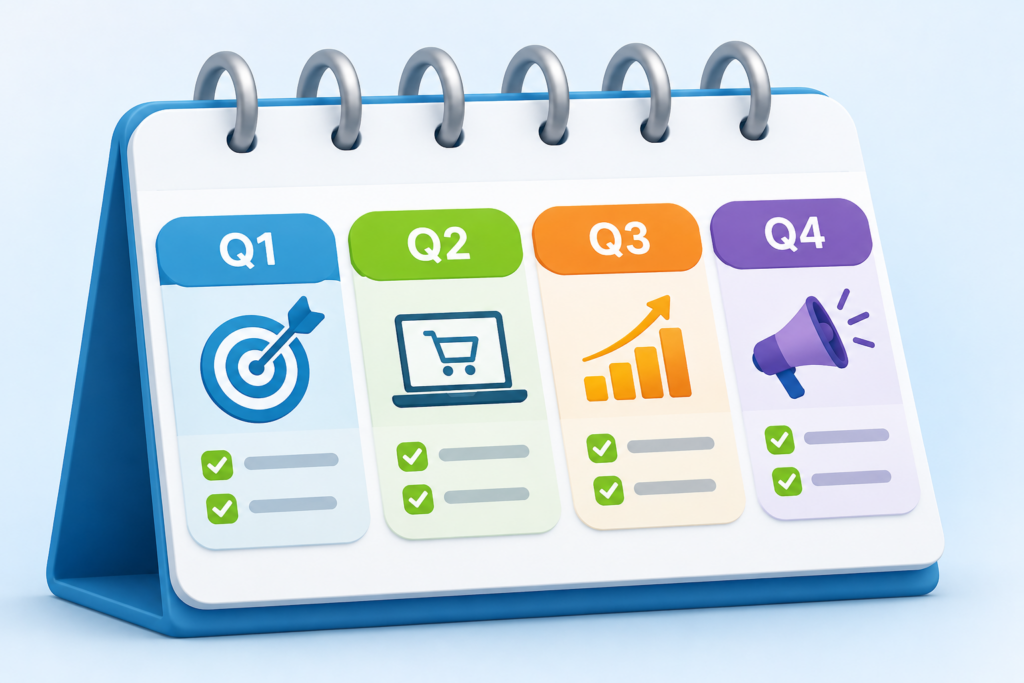
Give each quarter one main push and a short list of supporting work. Here’s an example for a service business that also sells online:
| Quarter | Main push | Supporting work |
|---|---|---|
| Q1 (Jan–Mar) | Fix the foundation: website, tracking, service pages | Clean up the email list, set up Google Ads conversion tracking |
| Q2 (Apr–Jun) | Turn on lead generation | Google Ads live, two blog posts a month, test a LinkedIn campaign |
| Q3 (Jul–Sep) | Scale what worked in Q2 | Monthly email to past leads, refresh Shopify product pages |
| Q4 (Oct–Dec) | Close the year and plan the next | Holiday e-commerce push, customer reviews, 2028 audit |
Your calendar will look different. The point is that each quarter has one job. When something new comes up mid-quarter, you can ask whether it helps that job. If not, it goes on the list for next quarter.
Step 6: Pick a few numbers and put the review dates on the calendar
Every channel gets one or two numbers. Not ten.
| Channel | What to track | Why it matters |
|---|---|---|
| SEO plus AEO | Organic leads, rankings for your main services, visits from AI assistants | Shows whether search and AI tools send you buyers |
| Paid media | Cost per qualified lead, leads that became customers | Spend that doesn’t produce customers gets cut |
| Replies and booked calls from past leads | Opens are nice; conversations pay the bills | |
| Shopify or e-commerce | Conversion rate, revenue per visitor | Traffic only matters if it buys |
Notice what’s missing: impressions, followers, clicks. They’re fine to watch. They just aren’t the goal.
Then put four review dates on your calendar now, one at the end of each quarter. An hour each. Look at the numbers, decide what to keep, cut or change, and update the plan.
A plan you review four times a year beats a perfect plan you never open.
Not sure where to start? Get a free audit.
Step 1 is the hard part. It’s tough to audit your own marketing when you’re also running the business.
So we are here to help review what’s working, what might need some changing and help set you up for a successful 2027.