



Artificial intelligence has reshaped Google Ads, expanding the role of automation in bidding, targeting, and campaign management. While these tools can improve efficiency and uncover valuable opportunities, they aren’t a replacement for strategic thinking. In our experience, the most successful campaigns combine Google’s AI capabilities with human expertise to ensure budgets, conversions, and business goals stay aligned. The result is better decision making, more meaningful performance data, and stronger long term outcomes.
Quick takeaways before you read on:
- AI can optimize campaigns quickly, but it can only work with the goals and data it’s given.
- Automated recommendations don’t always align with a company’s unique business objectives.
- Conversion tracking issues can lead AI to optimize for actions that don’t generate meaningful business results.
- Increased spending and higher conversion counts don’t automatically translate to better performance.
- Human expertise provides the business context, strategic oversight, and critical thinking that AI lacks.
- The strongest Google Ads strategies combine automation with ongoing human management and optimization.
Why Google Is Investing Heavily in AI

Google’s AI powered advertising tools exist for a reason. With access to massive amounts of data, they can identify patterns, adjust bids in real time, and surface opportunities that would be difficult to catch manually. For many advertisers, this has improved efficiency and made campaign management more scalable.
Google continues to push automation across its advertising platform, encouraging the use of Smart Bidding, automated recommendations, and AI driven campaign types. In the right context, these tools can absolutely improve performance and reduce manual workload.
But automation is only as effective as the signals it’s given. When the inputs are incomplete, misaligned, or poorly structured, the system will still optimize, but it may optimize toward the wrong outcomes.
When “More Conversions” Doesn’t Mean Better Results
One of the most common issues we see in Google Ads accounts is a disconnect between reported conversions and actual business impact.
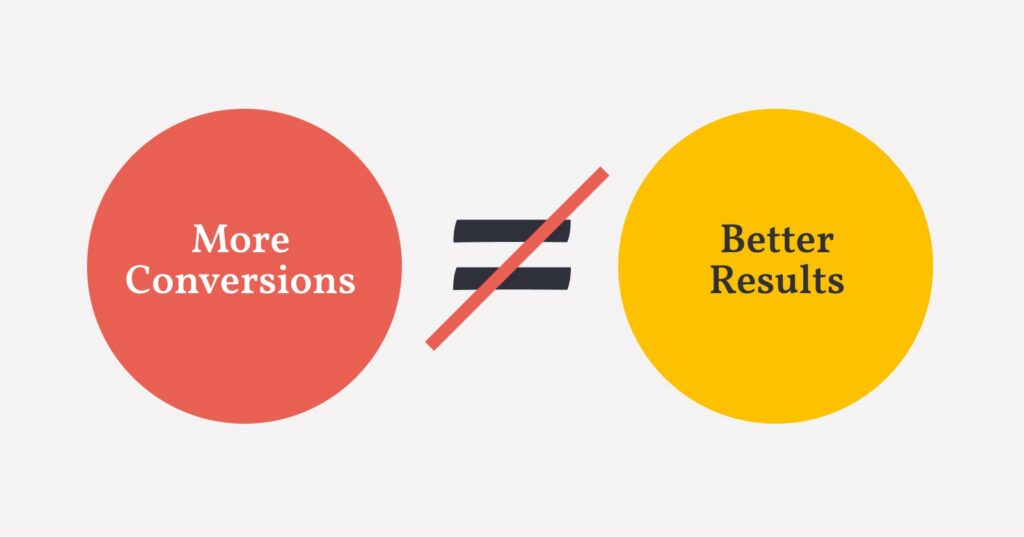
On the surface, performance can look strong. Conversion numbers go up, cost per conversion looks stable, and the platform may even recommend increasing budgets based on positive trends. But when those conversions are examined more closely, they don’t always reflect meaningful business results.
In some cases, the system is optimizing for actions that are too shallow or not tied directly to revenue, such as low intent form submissions, button clicks, or engagement based events. Once those actions are treated as primary conversions, Smart Bidding naturally starts prioritizing more of them.
The result is a campaign that looks successful in platform, but doesn’t necessarily translate into higher-quality leads or increased sales.
This isn’t a flaw in AI. It’s a reflection of how the system is designed: it will always optimize toward the signals it’s given, even if those signals don’t represent true business success.
The Real Cost of Overspending
Another challenge comes from the way Google aggressively promotes automation and expansion.
AI driven recommendations often encourage advertisers to increase budgets, broaden targeting, or adopt new campaign types. In some cases, this can unlock growth. In others, it can lead to unnecessary spend that doesn’t align with actual business capacity or demand.

What algorithms can’t fully account for are the real world constraints behind every business, including:
- Seasonal demand shifts
- Sales team capacity and lead follow-up speed
- Inventory or service limitations
- Geographic or market priorities
- Profit margins and customer lifetime value
Without this context, it’s easy for campaigns to scale spend faster than they should, or in directions that don’t support long term profitability.
This is where human oversight becomes critical at evaluating not just whether performance is improving, but whether that improvement actually supports the business behind it.
Understanding the Real World Behind the Data

At its core, effective Google Ads management is not just about optimizing metrics, it’s about understanding what those metrics mean in a real business environment.
Experienced marketers can connect campaign performance back to outcomes that matter: qualified leads, closed deals, revenue growth, and long term customer value. They can also identify when the data is telling an incomplete or misleading story.
This often involves asking questions that automation can’t answer on its own:
- Are these leads actually converting into customers?
- Is this traffic aligned with our ideal audience?
- Are we optimizing for volume or for value?
- Do the reported results match what’s happening in the sales pipeline?
- Are we measuring the right actions in the first place?
These are the nuances that shape whether a campaign is truly successful, not just whether it looks successful in a dashboard.
Real World Examples
Example: More Traffic Doesn’t Always Mean Better Results
In one account, Google’s AI driven expansion began targeting broader automotive searches that were only loosely related to the client’s niche products. While traffic increased and ad spend climbed, conversion rates declined and online purchases dropped. The platform successfully generated more clicks, but not from the right audience.
After removing automated expansion and rebuilding campaigns around high-intent searches, performance improved significantly. Conversion rates increased by 115%, and return on ad spend improved from approximately 2x to more than 6x.
The experience reinforced an important lesson: AI found more traffic, but human expertise found the right customers.
Example: Business Priorities Still Matter
In another account, Google’s automation successfully lowered cost per acquisition and generated additional conversions. On paper, performance looked strong. However, the campaigns had shifted budget toward products that were easiest to sell rather than the products the business wanted to promote.
By restructuring campaigns around priority products, seasonal launches, and specific merchandising goals, performance improved while aligning more closely with business objectives. Cost per acquisition reached its lowest point in account history, while return on ad spend exceeded 17x during a traditionally slower sales period.
The platform is optimized for efficiency. Human strategy optimized for the business.
The Future Isn’t Human vs. AI

The conversation around AI in advertising is often framed as a choice between automation and human control, but in reality, the most effective approach combines both.
AI excels at processing data, identifying trends, and making real-time adjustments at scale. Human expertise provides the strategy, context, and judgment needed to ensure those optimizations are actually aligned with business goals.
When these two work together, campaigns become more efficient and more intentional. Automation handles the complexity of execution, while humans guide the direction.
As Google Ads continues to evolve, that balance becomes even more important. Businesses that rely entirely on automation risk losing sight of the bigger picture, while those that ignore AI miss out on valuable efficiency gains.
The strongest results come from using both intentionally, strategically, and with a clear understanding of what success actually looks like.
Because in the end, effective advertising isn’t just about optimizing systems. It’s about understanding people, goals, and business outcomes, and that still requires a human perspective.