


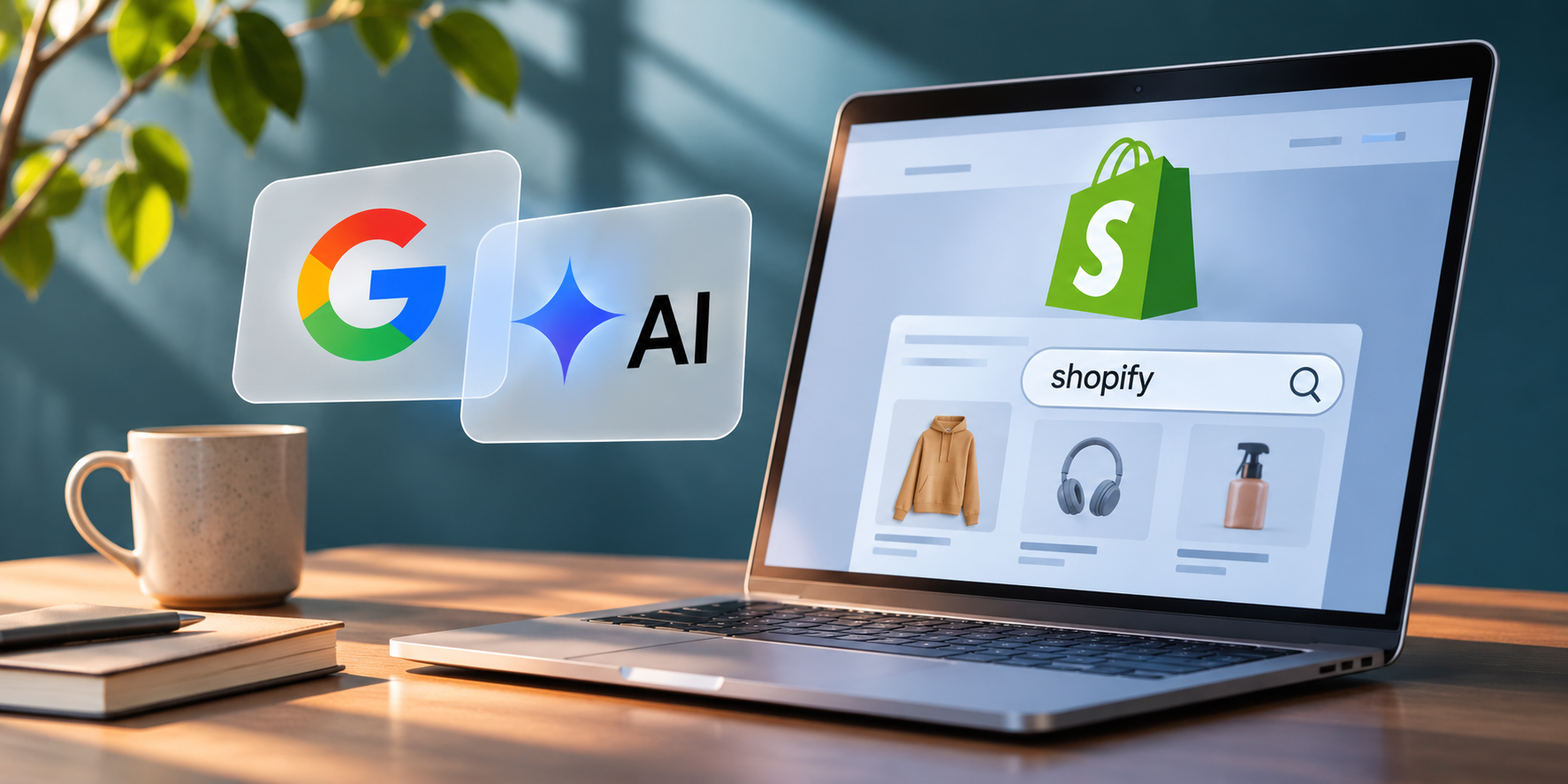
Shopify SEO for 2027 comes down to two jobs done with one set of fixes: earning rankings in Google and making your products easy for AI shopping assistants to find. Start with clean product data, strong collection pages, consistent URLs, structured data and a Google Merchant Center feed. Then confirm your AI sales channels are switched on.
Your next customer may never type your store name into Google. They might ask ChatGPT for a gift under $75, or ask Microsoft Copilot to compare three coffee grinders, and buy from whichever store the assistant surfaces. At the same time, Google still sends far more traffic. In Semrush’s tracking of 19 major retailers from November 1, 2025 to January 9, 2026, organic search drove about 18% of visits, while AI referrals drove about 0.15%.
So this is not an either-or choice. About 4,200 people in the US search “shopify seo” every month, and about 6,400 search “agentic commerce,” according to Ahrefs data from October 2026. Merchants who follow Shopify SEO best practices now will be ready for both. Most of the work below takes hours, not weeks.
What is different about Shopify SEO going into 2027?
The fundamentals have not changed. Google rewards fast, crawlable stores with useful pages. Shopify also handles a lot of the technical base for you, including an automatically generated sitemap.xml and basic Product, Organization and Website structured data in default themes.
What is new is the second audience. AI shopping assistants do not read your pages the way a shopper does. They draw on structured product data, including Shopify Catalog, a layer that organizes and standardizes product data for AI channels. That means weak product data hurts you twice: once in Google, and again when an assistant decides which products to recommend.
How do AI shopping assistants find your Shopify products?
According to Shopify’s own documentation, updated in June 2026, three pieces matter for agentic commerce, the term for AI agents that help people discover and buy products:

- Shopify Catalog is the structured product data layer. Eligible products are listed by default, and updates you make in your admin carry through to AI channels.
- Agentic Storefronts is an admin sales channel that connects your products to AI shopping platforms. It is automatically activated for eligible merchants, with no app to install.
- Universal Commerce Protocol (UCP) is an open standard, co-developed by Shopify and Google, that defines how AI agents transact with merchants.
Here is where it stands for store owners selling to US buyers. ChatGPT is live, and shoppers check out on your online store. Microsoft Copilot is live, with Copilot Checkout for eligible merchants. AI Mode in Google Search and the Gemini app are available to select US shops, with broader rollout underway. Shopify says purchasing across these channels is currently for US buyers only.
One detail is worth knowing. In 2025, Shopify said merchants would sell directly inside ChatGPT conversations. By March 2026, Shopify told Digital Commerce 360 that buyers find products in ChatGPT and complete purchases on the merchant’s own store. You stay the merchant of record, and orders show attribution to the AI channel that drove the sale.
Your first task takes five minutes. In your admin, open Settings, then Sales Channels, then Agentic Storefronts. Check which AI partners receive your product data and whether direct checkout is on or off for each channel.
What should you fix first? A Shopify SEO checklist for 2027
These Shopify SEO tips are ordered by impact. Use them as a Shopify SEO checklist, and tackle the first three before the rest.
- Fix product data before anything else. Google Shopping and AI assistants both depend on it. Write titles that say what the product is, using type, material, size or use, not just a brand name. Complete every product attribute and variant option. Write descriptions that answer the questions a buyer would ask: who it is for, what it is made of, what it fits and how to care for it.
- Rebuild your collection pages. Collection pages often carry the most organic traffic in a store. One Search Engine Land contributor reports that on the Shopify sites he has audited, they account for more than 60% of organic traffic. Put a short intro above the product grid and a longer, well-structured section below it. Link to related collections, buying guides and blog posts from that copy.
- Link to one URL per product. Shopify can show the same product at a main URL and at a collection-based URL. Canonical tags help, but pointing your grid links to the main product URL keeps your signals consistent. Ask your developer to check your theme, then crawl the site to confirm.
- Add structured data and test it. Default themes include basic Product schema, which is a starting point only. Shopify structured data for collection pages is usually missing, so consider adding CollectionPage markup, and add FAQ markup where you answer real questions. Use Google’s Rich Results Test to confirm that your Shopify product schema is being read correctly.
- Connect Google Merchant Center and Bing Merchant Center. Install the free Google and YouTube app, set up Google Merchant Center for Shopify, and submit your product feed. Some specialists also recommend submitting to Bing Merchant Center to reach AI-powered environments connected to OpenAI.
- Cut page weight. Remove apps you no longer use, compress oversized images and minify code. A Google and NitroPack study, cited by Search Engine Land, found that a 0.1-second faster load time can lift conversion rates by more than 10%.
- Decide who can crawl your store. Shopify has allowed robots.txt customization since 2021, using a robots.txt.liquid template. Blocking AI crawlers is a business decision, so make it on purpose rather than by default.
- Publish content that answers buying questions. Write buying guides, comparison pages and FAQs that open with a direct answer. Keep real customer reviews on product pages. This is the same format that helps content get cited in AI answers, as we cover in our guide to [AEO vs. SEO: link when live].
Skip the shortcuts. Stacking several SEO apps, stuffing keywords into product titles and chasing an llms.txt file will not move the needle. Industry opinion on llms.txt is still divided, and it is no substitute for clean product data and useful pages.
What should you do between now and January?
Black Friday is November 27, 2026, so split the work into three windows.
| When | Focus |
|---|---|
| Now through Nov 25 | Confirm your Agentic Storefronts settings. Fix titles and descriptions on your top 10 products. Check Google Merchant Center for disapproved products. Remove unused apps and compress images. |
| Black Friday through Dec 20 | Avoid big theme changes. Keep shipping cutoffs, return policies and store hours easy to find, because Semrush’s retailer data shows shoppers searching for exactly these in mid-December. Watch AI-channel orders in your Shopify admin. |
| January | Rewrite your top collection pages, add schema, clean up duplicate product URLs and publish two or three buying guides. Then compare Search Console impressions and clicks against November. |
How do you measure Shopify SEO and AI visibility?
Track four things monthly. Use Google Search Console for impressions and clicks by collection and product page. Use your Shopify admin to see orders attributed to AI channels. Set up a GA4 channel group for AI-assistant referrals so you can see visits that start in ChatGPT, Copilot or Gemini. Finally, run the same ten shopping prompts in each assistant and record whether your products appear.
Expect AI traffic to be small at first. Treat it as an early signal, not a replacement for your Google numbers.
What are we seeing at MINDSCAPE?
We have been updating out our client Shopify stores for AI Search and are already seeing fantastic results.
Across two Shopify stores, one retail and one B2B, AI-referred sessions grew 3–5x within a year of refreshing product and collection content.
One brand’s AI-attributed revenue grew more than 4x over its baseline, with nearly all of it coming from ChatGPT.
The share of pages cited by ChatGPT grew 6–8x for both brands.
We rewrote and restructured their Shopify content so AI assistants could easily find, understand, and cite it. Within months, AI-referred visitors became a meaningful, high-converting traffic source.
Frequently asked questions
Is Shopify good for SEO?
Shopify handles many technical basics, including a generated sitemap and editable page titles and meta descriptions. Rankings still depend on your product data, content, page speed and links, so a Shopify store needs ongoing SEO work like any other site.
Do I need an app to sell in ChatGPT?
According to Shopify, no. Agentic Storefronts is an admin sales channel that is automatically activated for eligible merchants, and no app installation is needed. It is currently available for US buyers.
Will AI shopping replace Google traffic?
Not yet. In Semrush’s retailer data, AI referrals were about 0.15% of visits compared with about 18% from organic search. Treat AI search as an additional channel and plan for both.
How long does Shopify SEO take to work?
Expect months, not weeks. Google needs to recrawl and reassess your pages, and new content takes time to earn rankings. Product data and speed fixes can improve conversion sooner.
Do I need a schema app for Shopify?
Not always. Most themes include basic Product schema. You can add CollectionPage and FAQ markup through theme code or with a developer, then test it in Google’s Rich Results Test.
Want a second set of eyes on your store?
MINDSCAPE is a Grand Rapids, Michigan agency that builds and markets Shopify stores. Book a free Shopify SEO review and we will run your store through Ahrefs, the SEO platform we use for our own site and for client work. It shows us your technical issues, the keywords you already rank for and how you compare with competitors. We will pair that with a hands-on look at your product data, collection pages and AI channel settings, then tell you what to fix first. If you would rather have a team handle it, ask us about our Shopify SEO services.
Sources
- Shopify: Agentic Commerce on Shopify: How It Works (updated June 18, 2026)
- Shopify: AI commerce at scale (Jan 11, 2026)
- Digital Commerce 360: Shopify changes its integration approach with ChatGPT (Mar 17, 2026)
- Semrush: Holiday shopping 2025 traffic data (Nov 1, 2025 – Jan 9, 2026)
- Search Engine Land: Shopify SEO AI-readiness playbook (Gert Mellak)
- Keyword volumes: Ahrefs Keywords Explorer, US, October 2026